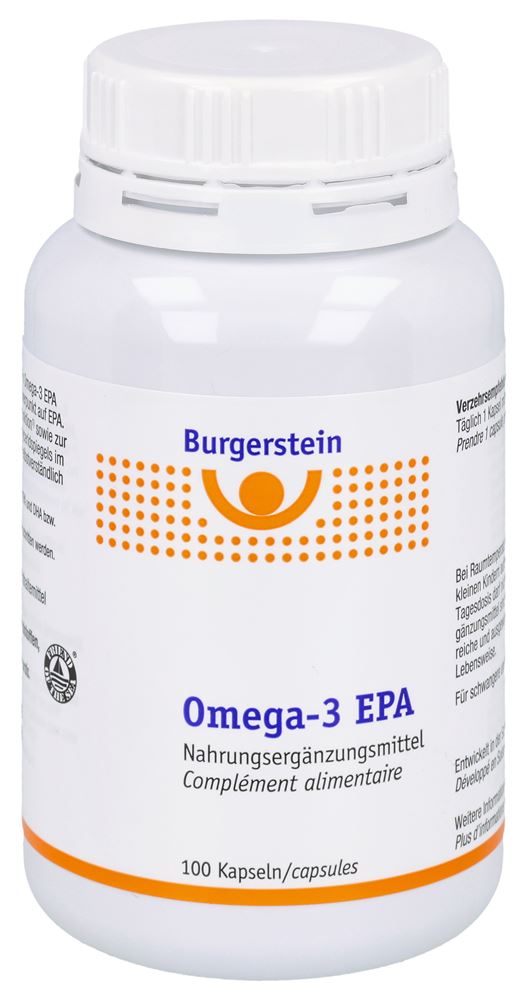
Burgerstein Omega-3 EPA est une préparation à base d’huile de poisson particulièrement riche en EPA (acide eicosapentaénoïque), un précieux acide gras oméga-3.

Burgerstein Omega-3 EPA se caractérise par une teneur élevée en acide gras oméga-3 EPA et offre un moyen simple de compléter son alimentation de manière ciblée avec de l’EPA.
Burgerstein Omega-3 EPA est particulièrement indiqué pour:
| Valeurs nutritives |
Apport journalier |
VNR* |
| Énergie | 30 kJ / 7,5 kcal | - |
| Lipides dont: Acides gras saturés Acides gras monoinsaturés Acides gras polyinsaturés dont: Acides gras Omega-3 (378 mg EPA et 92 mg DHA) |
0,7 g 14 mg** 28 mg** 651 mg** 564 mg** 470 mg |
- - - - - - |
| Glucides dont sucre dont des polyols |
< 0,1 g 0,1 g < 0,1 g |
- - - |
| Fibres alimentaires | 0,0 g | - |
| Protéines | 0,2 g | - |
| Sel | 0,0 g | - |
| Vitamine E | 7,5 mg | 62% |
* VNR = Valeurs nutritionnelles de référence
** Des variations sont possibles, produit naturel
Prendre 1 capsule par jour au repas.
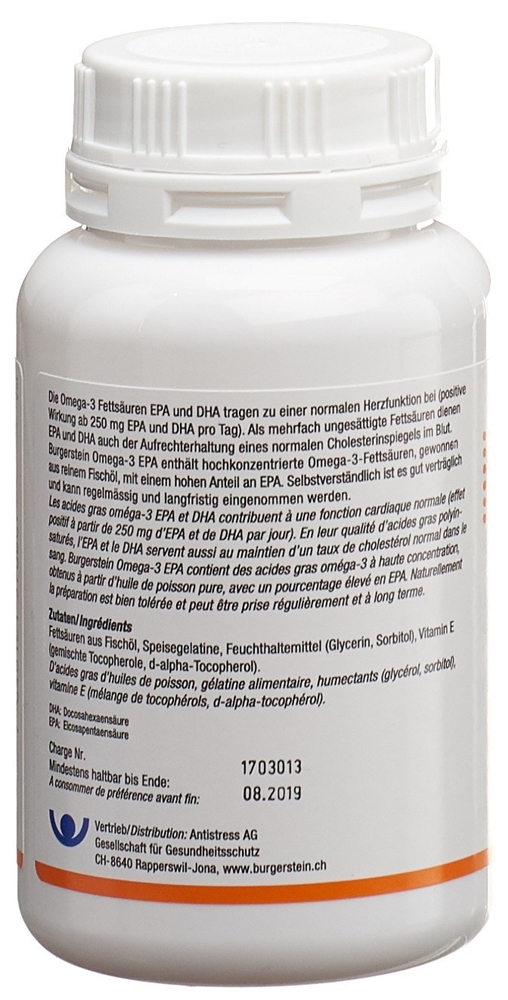
Huile de poisson, agent d’enrobage (gélatine alimentaire (poisson)), humectants (glycérine), tocophérols mixtes, D-alpha-tocophérol.
Conserver à température ambiante. Conserver hors de la portée des jeunes enfants. L’apport journalier recommandé indiqué ne doit pas être dépassé. Un complément alimentaire ne remplace pas une alimentation variée et équilibrée ni un mode de vie sain.
Ne convient pas aux femmes enceintes ou qui allaitent.
Développé en Suisse, fabriqué en Allemagne.
Les personnes qui ne mangent pas de poisson ou qui en mangent peu trouvent peu d’EPA et de DHA dans leur alimentation. De plus, notre organisme ne produit ces deux acides gras qu’en petites quantités à partir de l’acide alpha-linolénique. Une supplémentation ciblée des apports en DHA peut donc être judicieuse, en particulier chez les personnes qui mangent peu ou pas de poisson.
Oui. La gamme Burgerstein Omega-3 comprend les produits suivants :
Burgerstein Omega-3 DHA avec une teneur plus élevée en DHA, Burgerstein Omega-3 EPA avec une teneur plus élevée en EPA, et Burgerstein Omega-3 vegan pour les personnes qui souhaitent renoncer à l'huile de poisson ou qui ont une alimentation végane. Burgerstein Omega-3 liquid offre en outre une alternative sous forme liquide.
Les acides gras oméga-3 sont un groupe d’acides gras polyinsaturés très importants pour l’organisme. Les principaux acides gras oméga-3 sont l’acide alpha-linolénique (ALA), l’acide eicosapentaénoïque (EPA) et l’acide docosahexaénoïque (DHA). L’ALA est surtout présent dans les aliments d’origine végétale tels que l’huile de lin et les noix. L’EPA et le DHA se trouvent en particulier dans les poissons gras de mer ainsi que dans certaines algues.
Le DHA (acide docosahexaénoïque) et l’EPA (acide eicosapentaénoïque) sont des acides gras polyinsaturés que l’on trouve, à l’état naturel, principalement dans les poissons gras de mer, mais aussi dans certaines algues. Ils remplissent différentes fonctions dans l’organisme.
Le DHA est particulièrement important pour le cerveau et les yeux1. Associé au DHA, l’EPA joue un rôle important dans la fonction cardiaque. 3
Selon les besoins particuliers, une préparation d’oméga-3 plus riche en DHA ou en EPA peut donc être judicieuse.
1 Effet bénéfique obtenu par la consommation journalière de 250 mg de DHA.Les acides gras oméga-3 sont présents aussi bien dans les aliments d’origine animale que végétale. Les poissons gras de mer comme le saumon, le hareng, le maquereau et la sardine sont de bonnes sources d’acides gras oméga-3 EPA et DHA. Différents aliments d’origine végétale tels que les graines de lin, les graines de chia, les noix ainsi que l’huile de lin et de colza contiennent des oméga-3 principalement sous forme d’acide alpha-linolénique (ALA).
L’huile de poisson et l’huile d’algues se distinguent surtout par leur origine – toutes deux fournissent d’importants acides gras oméga-3.
L’indice TOTOX («Total Oxidation Value») indique le degré d’oxydation d’une huile, c’est-à-dire son vieillissement. Il est surtout utilisé pour évaluer la qualité des huiles de poisson et d’algues contenues dans les produits à base d’oméga‑3.
Pour l’huile de poisson, un indice TOTOX favorable est généralement inférieur à 10.
À titre d’indication pratique de la qualité d’une huile (selon la GOED – Global Organization for EPA et DHA-Omega-3s):
Les produits oméga-3 de Burgerstein présentent systématiquement un indice TOTOX très faible (nettement < 10), qui fait l’objet de contrôles réguliers.
Source : burgerstein.ch · mis à jour 22.11.2026
Burgerstein Omega-3 EPA ist ein Fischölpräparat mit einem besonders hohen Gehalt an der wertvollen Omega-3-Fettsäure EPA (Eicosapentaensäure).
Burgerstein Omega-3 EPA zeichnet sich durch einen hohen Anteil der Omega-3-Fettsäure EPA aus und bietet eine einfache Möglichkeit, die Ernährung gezielt mit EPA zu ergänzen.
Burgerstein Omega-3 EPA ist besonders geeignet für:
|
Nährwerte |
Pro Tagesportion |
NRV* |
| Energie | 30 kJ / 7,5 kcal | - |
| Fett davon: gesättigte Fettsäuren einfach ungesättigte Fettsäuren mehrfach ungesättigte Fettsäuren davon: Fettsäuren Omega-3 (378 mg EPA und 92 mg DHA) |
0,7 g 14 mg** 28 mg** 651 mg** 564 mg** 470 mg |
- |
| Kohlenhydrate davon Zucker davon mehrwertige Alkohole |
< 0,1 g 0,1 g < 0,1 g |
- - - |
| Nahrungsfasern | 0,0 g | - |
| Eiweiss | 0,2 g | - |
| Salz | 0,0 g | - |
| Vitamin E | 7,5 mg | 62% |
* NRV = Nutrient reference value (Nährstoffbezugswert)
** Kann variieren, Naturprodukt
DHA: Docosahexaensäure
EPA: Eicosapentaensäure
Täglich 1 Kapsel mit einer Mahlzeit einnehmen.
Fischöl, Überzugsmittel (Speisegelatine (Fisch)), Feuchthaltemittel (Glycerin), gemischte Tocopherole, D-alpha-Tocopherol.
Bei Raumtemperatur lagern. Ausserhalb der Reichweite von kleinen Kindern aufbewahren. Die angegebene empfohlene Tagesdosis darf nicht überschritten werden. Nahrungsergänzungsmittel sind kein Ersatz für eine abwechslungsreiche und ausgewogene Ernährung sowie eine gesunde Lebensweise.
Für schwangere und stillende Frauen nicht geeignet.
Entwickelt in der Schweiz, hergestellt in Deutschland.
Menschen, die keinen oder wenig Fisch essen, nehmen nur wenig EPA und DHA mit der Ernährung zu sich. Dazu kommt, dass unser Körper die beiden Fettsäuren nur in kleinen Mengen aus der Alpha-Linolensäure herstellt. Eine gezielte Ergänzung der DHA-Zufuhr kann daher insbesondere bei Personen sinnvoll sein, die wenig oder keinen Fisch essen.
Ja. Es gibt folgende Produkte von Burgerstein Omega-3:
Burgerstein Omega-3 DHA mit einem höheren DHA-Anteil, Burgerstein Omega-3 EPA mit einem höheren EPA-Anteil sowie Burgerstein Omega-3 vegan für Personen, die auf Fischöl verzichten möchten oder sich vegan ernähren. Mit Burgerstein Omega-3 liquid steht zudem eine flüssige Variante zur Verfügung.
Omega-3-Fettsäuren sind eine Gruppe von mehrfach ungesättigten Fettsäuren, die für den Körper sehr wichtig sind. Zu den wichtigsten Omega-3-Fettsäuren gehören Alpha-Linolensäure (ALA), Eicosapentaensäure (EPA) und Docosahexaensäure (DHA). ALA kommt vor allem in pflanzlichen Lebensmitteln wie Leinöl und Baumnüssen vor. EPA und DHA finden sich insbesondere in fettreichen Meeresfischen sowie in bestimmten Algen.
DHA (Docosahexaensäure) und EPA (Eicosapentaensäure) sind mehrfach ungesättigte Fettsäuren, die natürlicherweise vor allem in fettreichen Meeresfischen, aber auch in gewissen Algen vorkommen. Sie übernehmen im Körper unterschiedliche Aufgaben.
DHA ist insbesondere für das Gehirn und für die Augen1 von hoher Bedeutung. EPA spielt gemeinsam mit DHA eine wichtige Rolle für die Herzfunktion. 3
Je nach gewünschtem Schwerpunkt kann daher ein Omega-3-Präparat mit einem höheren Anteil an DHA oder EPA sinnvoll sein.
1 Positive Wirkung bei einer täglichen Aufnahme von 250 mg DHA.Omega-3-Fettsäuren kommen sowohl in tierischen als auch in pflanzlichen Lebensmitteln vor. Fettreiche Meeresfische wie Lachs, Hering, Makrele und Sardinen sind besonders gute Quellen für die Omega-3-Fettsäuren EPA und DHA. Pflanzliche Lebensmittel wie Leinsamen, Chiasamen, Baumnüsse sowie Lein- und Rapsöl enthalten Omega-3 hauptsächlich in Form von Alpha-Linolensäure (ALA).
Fischöl und Algenöl unterscheiden sich vor allem in ihrer Herkunft – beide liefern wichtige Omega-3-Fettsäuren.
Der TOTOX-Wert („Total Oxidation Value“) zeigt, wie stark ein Öl oxidiert – also gealtert ist. Er wird vor allem zur Qualitätsbewertung von Fisch- und Algenöl in Omega‑3-Produkten verwendet.
Ein guter TOTOX-Wert bei Fischöl liegt typischerweise unter 10.
Als praktische Orientierung (gemäss GOED - Global Organization for EPA und DHA-Omega-3s):
Die Omega-3 Produkte von Burgerstein weisen durchgehend sehr niedrige TOTOX-Werte auf (deutlich <10), die regelmässig kontrolliert werden.
Source : burgerstein.ch · mis à jour 22.11.2026
Burgerstein Omega-3 EPA is a fish oil product with a particularly high content of the valuable omega-3 fatty acid EPA (eicosapentaenoic acid).
Burgerstein Omega-3 EPA contains high levels of the omega-3 fatty acid EPA and offers an easy way to supplement your diet specifically with EPA.
Burgerstein Omega-3 EPA is particularly suitable for:
|
Nutritional values |
Per daily portion |
NRV* |
| Energy | 30 kJ / 7,5 kcal | - |
| Fat of which: saturated fatty acids monounsaturated fatty acids polyunsaturated fatty acids of which: omega-3 fatty acids (378 mg EPA and 92 mg DHA) |
0,7 g 14 mg** 28 mg** 651 mg** 564 mg** 470 mg |
- |
| Carbohydrates of which sugars of wihich polyols |
< 0,1 g 0,1 g < 0,1 g |
- - - |
| Dietary fibre | 0,0 g | - |
| Protein | 0,2 g | - |
| Salt | 0,0 g | - |
| Vitamin E | 7,5 mg | 62% |
* NRV = Nutrient reference value
**May vary; natural product
DHA: docosahexaenoic acid
EPA: eicosapentaenoic acid
Take 1 capsule a day with a meal.
Fish oil, coating agent (edible gelatine (fish)), humectant (glycerine), mixed tocopherols, D-alpha-tocopherol
Store at room temperature. Keep out of the reach of young children. Do not exceed the recommended daily dose. Food supplements are not a substitute for a varied and balanced diet and a healthy lifestyle.
Not suitable for pregnant or breastfeeding women.
Developed in Switzerland, manufactured in Germany.
People who eat little or no fish consume little EPA and DHA in their diet. In addition, our body only produces the two fatty acids in small quantities from alpha-linolenic acid. Targeted supplementation of DHA may therefore be particularly useful for people who eat little or no fish.
Yes. Burgerstein Omega-3 offers the following products:
Burgerstein Omega-3 DHA, with a higher DHA level; Burgerstein Omega-3 EPA, with a higher EPA level and Burgerstein Omega-3 vegan, for people who want to avoid fish oil or follow a vegan diet. There is also a liquid version available with Burgerstein Omega-3 liquid.
Omega-3 fatty acids are a group of polyunsaturated fatty acids that are very important for the body. The most important omega-3 fatty acids include alpha-linolenic acid (ALA), eicosapentaenoic acid (EPA) and docosahexaenoic acid (DHA). ALA is mainly found in plant-based foods such as linseed oil and walnuts. EPA and DHA are found in particular in oily marine fish and in certain kinds of algae.
DHA (docosahexaenoic acid) and EPA (eicosapentaenoic acid) are polyunsaturated fatty acids that occur naturally primarily in oily marine fish, but also in certain kinds of algae. They perform different tasks in the body.
DHA is particularly important for the brain and the eyes1. Together with DHA, EPA plays an important role in cardiac function. 3
This means that, based on specific requirements, an omega-3 supplement with a higher proportion of DHA or EPA may be useful.
1 Positive effect with a daily intake of 250 mg DHA.Omega-3 fatty acids are found in both animal and plant foods. Oily marine fish such as salmon, herring, mackerel and sardines are particularly good sources of the omega-3 fatty acids EPA and DHA. Plant-based foods such as flaxseed, chia seeds, tree nuts, linseed oil and rapeseed oil contain omega-3 mainly in the form of alpha-linolenic acid (ALA).
Fish oil and algae oil differ mainly in their origin – both provide important omega-3 fatty acids.
The TOTOX (total oxidation) value shows how much an oil has oxidised, i.e. aged. It is mainly used to assess the quality of fish oil and algae oil in omega‑3 products.
A good TOTOX value for fish oil is typically below 10.
The following provides a practical guide (according to GOED – Global Organization for EPA and DHA-Omega-3s):
Burgerstein’s omega-3 products are checked regularly and consistently have very low TOTOX values (clearly <10).
Source : burgerstein.ch · mis à jour 22.11.2026
Les informations complémentaires de la base de données officielle Swissmedic V2 ne sont pas disponibles pour ce produit.